

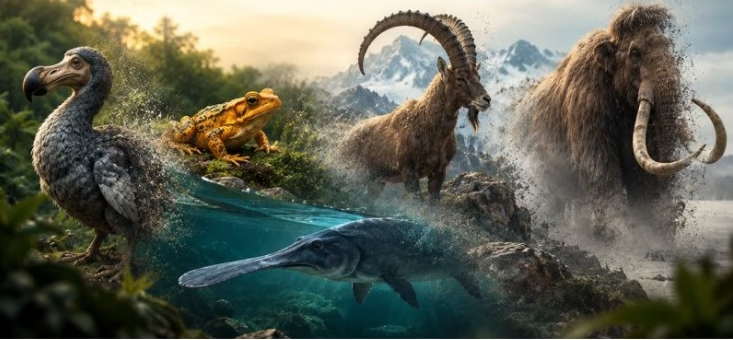
The dodo, the golden toad and the Chinese paddlefish are among the animals that have disappeared from the natural world. Each had a distinct habitat, ecological role and evolutionary history. Today, none has a surviving population.
Their disappearance represents more than the loss of individual animal species. Extinction removes unique forms of life and can disrupt the ecological relationships that connect plants, animals and their surrounding environments.
Although extinction can occur through natural processes, human activities have accelerated the decline of many species through hunting, overfishing, habitat destruction, pollution and the introduction of invasive species.
As scientific research advances, however, another possibility has attracted growing attention: could some extinct animals be brought back through biotechnology?
The idea is fascinating, but it also raises an important question. If science is exploring ways to recreate lost animals, are enough efforts being made to protect the species still living among us?
Four Extinct Animals and the Stories Behind Their Disappearance
The circumstances surrounding extinction differ from one species to another. Some disappear following direct exploitation, while others are affected by environmental changes, disease or several interacting pressures.
The Dodo
The dodo was a flightless bird native to Mauritius in the Indian Ocean. Following the arrival and settlement of humans on the island, the bird faced hunting pressure and the introduction of animals such as rats, pigs, cats and dogs. These introduced animals threatened its eggs and young, while habitat changes further affected its survival. The dodo disappeared during the seventeenth century.
The Golden Toad
Native to the cloud forests of Costa Rica, the golden toad became famous for its striking appearance. Its population declined dramatically before the species was declared extinct. Research has linked its disappearance to successive periods of extreme drought associated with changes in climate. Its extinction demonstrates how species with specialised habitat requirements can be particularly vulnerable to environmental changes.
The Chinese Paddlefish
One of the world’s largest freshwater fish, the Chinese paddlefish once inhabited China’s Yangtze River. Its population declined through overfishing and habitat fragmentation, with the construction of dams and other changes to the river system contributing to the pressure on the species. Researchers estimate that it became functionally extinct by 1993 and disappeared completely by around 2005–2010.
The Pyrenean Ibex
The Pyrenean ibex, also known as the bucardo, was a subspecies of the Spanish ibex found in the Pyrenees mountains. Centuries of hunting contributed to its decline, leaving only a small population. The last known individual, a female named Celia, died in January 2000. Although scientists later succeeded in producing a cloned animal using preserved cells, the newborn survived for only a few minutes.
These examples show that extinction does not follow a single pattern. However, they also demonstrate how pressures on wildlife can become irreversible when populations are unable to recover.
What Happens When a Species Disappears?
The loss of an animal does not necessarily end with its disappearance. Species are connected to other organisms through food chains, pollination, seed dispersal, predation and other ecological relationships.
When one species disappears, these relationships can be disrupted. Animals that depend on it for food may lose an important resource, while plants that rely on it for seed dispersal may experience difficulties reproducing.
The disappearance of a species can therefore produce consequences beyond the animal itself, affecting other organisms and the wider ecosystem.
This is particularly important in habitats where species have evolved together over long periods. Replacing one organism does not automatically restore the ecological relationships that developed around it.
Extinction also represents the permanent loss of genetic diversity and evolutionary history. Once the last individual of a species dies, the unique combination of characteristics developed through generations of evolution is no longer naturally available.
Can Science Bring Extinct Animals Back?
The possibility of bringing extinct animals back is commonly described as de-extinction.
Scientists are exploring different approaches, including cloning, genetic engineering and selective breeding. These methods aim to reproduce certain characteristics of extinct organisms or create animals that are genetically similar to their extinct relatives.
The Pyrenean ibex provides an important example of how far this research has progressed. In 2003, scientists successfully produced a clone using preserved cells from the last known individual. However, the newborn died shortly after birth because of a lung abnormality. It was a significant scientific development, but not a successful restoration of a viable population.
Other de-extinction proposals have attracted scientific and public interest, but recreating an animal is only one part of the challenge.
A species also needs a suitable habitat, adequate food sources, genetic diversity and the ecological conditions required for survival and reproduction. An animal produced through biotechnology cannot automatically be returned to an environment that has changed or disappeared.
There are also questions about the resources required for these projects and whether they might divert attention or funding from protecting endangered species that still exist.
Why Preventing Extinction Matters More
Scientific innovation has an important role in conservation. Genetic research, reproductive technologies and other advances can support efforts to protect threatened populations and preserve biodiversity.
However, the possibility of recreating an extinct animal should not create the impression that extinction is easily reversible.
A recreated animal may resemble an extinct species, but restoring the original ecological conditions and relationships is a much more complex undertaking. The habitat may have been destroyed, food sources may have disappeared, and other species that once interacted with the animal may no longer exist.
Conservation efforts must therefore prioritise preventing species from reaching the point of extinction.
Protecting natural habitats, controlling illegal hunting and wildlife trade, managing fisheries sustainably, reducing pollution and addressing climate-related threats are essential steps. Governments, conservation organisations, researchers and local communities all have responsibilities in this process.
Protecting biodiversity also requires recognising the value of less familiar species, not only animals that attract widespread public attention. Every species contributes to the natural systems in which it exists, although its ecological role may not always be fully understood.
Protecting What We Still Have
The disappearance of the dodo, golden toad, Chinese paddlefish and Pyrenean ibex reminds us that the natural world is not an unlimited resource.
Scientific progress may offer new ways to study, preserve or potentially recreate aspects of lost biodiversity. But technology cannot guarantee the restoration of everything that extinction takes away.
The more practical priority is to protect species while they still have viable populations, preserve the habitats they depend on and address the environmental pressures threatening their survival.
We should continue advancing conservation science, but we must not allow the possibility of bringing back extinct animals to weaken the urgency of protecting those still living.
Preventing extinction is not only easier than attempting to reverse it. It is also the most responsible way to safeguard the diversity of life for future generations.