

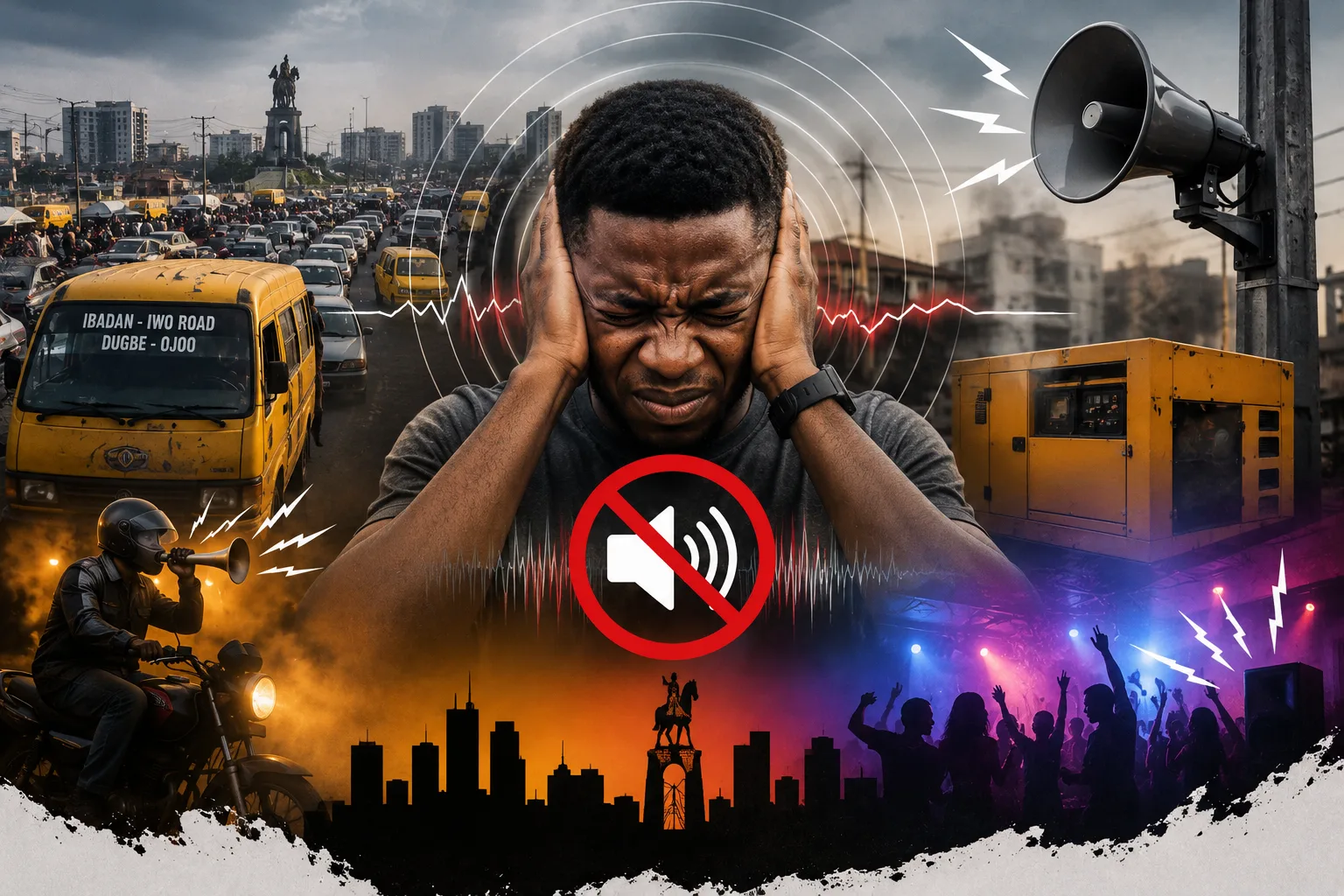
When conversations around environmental pollution come up, most people immediately think of flooding, poor waste disposal, blocked drainage channels, or air pollution. Noise pollution hardly gets mentioned. For many people, noise is simply seen as part of daily life or something annoying, perhaps, but not serious enough to be treated as a major environmental concern.
In Ibadan, excessive noise has become so common that many residents no longer consider it a problem. The constant blaring of horns along major roads such as Iwo Road, Sango, Bodija, and Dugbe, the nonstop humming of generators in residential areas like Akobo and Mokola, and the regular noise from roadside businesses have become part of everyday life. Add loudspeakers from religious centres, event halls, bars, and late-night parties, and silence is becoming increasingly rare in many parts of the city.
Because people are used to this level of noise, it is easy to dismiss it as normal city activity. But experts warn that what many residents have accepted as routine may be causing more harm than they realise. The danger with noise pollution is that it often builds quietly over time, with many people unaware of its effects until the consequences become severe.
Unlike flooding or waste pollution, noise pollution cannot be seen. There are no visible signs of damage like dirty floodwater on roads or piles of refuse in public spaces. This invisibility is one reason the issue is often ignored. However, the fact that noise leaves no visible trace does not make it harmless. Its effects on human health can be serious and long-lasting.
Health experts say regular exposure to loud noise can affect both the physical and mental wellbeing of individuals. One of the most common consequences is hearing damage. People who work in noisy environments such as transport hubs, busy markets, construction sites, and entertainment spaces are particularly vulnerable because of repeated exposure to high sound levels over long periods.

The danger is that hearing loss caused by excessive noise rarely happens overnight. It often develops gradually, making it difficult for people to notice the damage early enough. By the time symptoms become obvious, the condition may already be severe or permanent. This makes prevention especially important.
Beyond hearing problems, noise pollution can also affect mental wellbeing. Constant exposure to loud sound keeps the body in a state of alertness, making it difficult to properly relax. Over time, this can increase stress levels and contribute to irritability, fatigue, anxiety, and poor concentration. For students, workers, and business owners, this can affect productivity and overall performance.
Sleep disruption is another major concern. In many parts of Ibadan, uninterrupted sleep is becoming harder because of generators, traffic noise, loud music, and late-night social activities. Even when the noise does not completely wake a person, it can interrupt normal sleep cycles and reduce sleep quality. Poor sleep over time can affect memory, productivity, immune function, and general health.
Medical studies have also linked long-term exposure to excessive noise with high blood pressure and increased risk of heart-related conditions. This is particularly concerning because many residents may not connect these health issues to their environment. What seems like ordinary daily noise may actually be placing the body under constant pressure.
Children are also among the most vulnerable. For schools located near busy roads or commercial areas such as Challenge, Ojoo, and Gate, excessive noise can interfere with effective learning. Background noise can affect concentration, listening ability, classroom engagement, and information retention. In a city with a large student population like Ibadan, this creates an additional challenge for quality education.
One major reason noise pollution remains poorly addressed is public attitude. Many people simply see it as unavoidable. Phrases like “it is normal” or “that is just how the city is” are common responses whenever the issue comes up. But getting used to noise does not mean the body is unaffected. People may adapt mentally while still suffering physically from the long-term effects.
As Ibadan continues to expand, the problem may worsen if deliberate action is not taken. More vehicles, more businesses, more construction activity, and continued dependence on generators all point to higher noise levels across the city. Without proper regulation and awareness, the problem could become even more difficult to manage.
Addressing noise pollution will require effort from both authorities and residents. Environmental regulations on acceptable noise levels need stronger enforcement, especially in residential areas, schools, and hospitals. Religious centres, businesses, event organisers, and entertainment venues also need to be more conscious of how their activities affect surrounding communities. Improved power supply would also help reduce dependence on generators, which remain one of the biggest contributors to noise pollution in the city.
More importantly, there is a need for public awareness. Many residents still see noise pollution as a minor inconvenience, but it is far more than that. It is a public health issue that deserves serious attention. If Ibadan is serious about sustainable development and improving quality of life, then conversations about environmental protection must include noise pollution.