
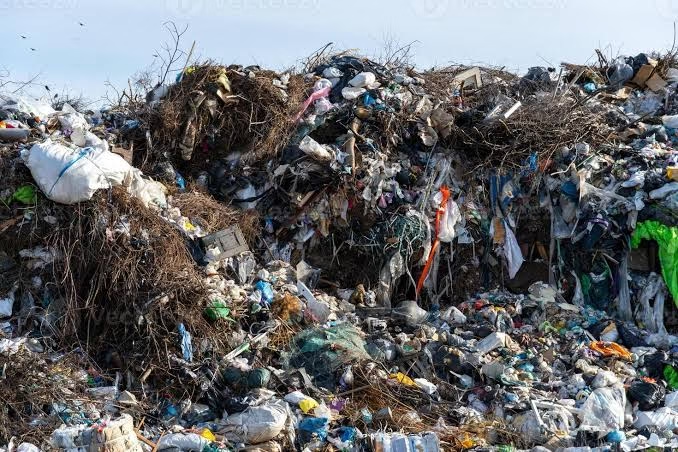
Environmental pollution is often discussed in terms of waste-management systems, infrastructure, government policies and enforcement. But another factor can influence how communities respond to pollution: social behaviour.
Consider a street where a plastic bottle has already been discarded. Another person may see the existing litter and feel less discouraged about adding another piece of waste. A drainage channel filled with rubbish can create the impression that improper disposal is already accepted.
Over time, repeated behaviour can become normal within a community.
This is where social norms can influence environmental practices. People often take cues from the behaviour of those around them. When littering and improper waste disposal are common and rarely challenged, they can become behaviours that attract little social attention.
The reverse can also happen.
When responsible environmental behaviour becomes visible and socially accepted, it can encourage others to follow. A person who sees colleagues using reusable bottles, separating household waste or disposing of rubbish properly may be more likely to adopt similar practices.
This does not mean that social influence alone can solve environmental problems. People need practical systems that make responsible behaviour possible. Communities require accessible waste-collection services, adequate disposal facilities and, where appropriate, recycling infrastructure. Effective environmental policies and enforcement also remain important.
However, infrastructure can be undermined when social behaviour consistently works against it.
A community may have waste bins, for example, but still struggle with littering if residents do not use them. Similarly, waste separation becomes difficult when households are not aware of how to separate materials or when collection systems subsequently mix the different waste streams.
Changing environmental behaviour therefore involves more than telling people what not to do. It can also involve making responsible practices visible, accessible and socially expected.
Families can encourage children to develop responsible waste-disposal habits. Schools can incorporate environmental practices into everyday activities. Businesses and workplaces can encourage waste separation and reusable alternatives, while communities can recognise and support local environmental initiatives.
Social approval can also influence behaviour. When responsible environmental practices are treated as ordinary and desirable, they can become easier for others to adopt. Conversely, when harmful practices are consistently ignored, they may continue without challenge.
Environmental protection is therefore partly a question of what societies come to regard as normal.
Pollution does not become widespread only because people lack information. Behaviour is also shaped by habits, convenience, social expectations and the actions people observe around them.
Changing those expectations can form part of the broader response to environmental challenges.
If irresponsible disposal can spread through social influence, responsible environmental behaviour can spread in the same way.
A cleaner community may therefore require not only better infrastructure and stronger policies, but also a culture in which protecting shared spaces becomes an ordinary part of everyday life.


